
Accident-Prone


Accident-Prone

Tuesday afternoon I absentmindedly poured boiling water on my foot. Thursday morning I wrenched my lower back while carrying heavy boxes. Since then I've been in constant pain, or some variation thereof. As a result, focusing on keyboard practice has been difficult, so my last two sessions have been short and not all that productive.

My mishaps remind me of the book Accident Prone, A History of Technology, Psychology and Misfits of the Machine Age. It posits that people who are susceptible to accidents could be manifesting an unconscious intention for self-destruction or some other radical change in their life.

Take for instance the guy who was hit by a truck. Was it because he so desperately wanted to be rich that his unconscious manifested it in the only way he could?

I'm not saying either way, but I do know that unresolved emotional-psychological issues lurk underneath the threshold of consciousness and influence our decision-making in very real ways. I designed Critical Stimulus (based on Carl Jung's Word Association Method) to expose these complexes.

I will probably use Critical Stimulus on myself tomorrow and see what it unearths. You can read about other complexes it has uncovered at CriticalStimulus.com.

On a related note, this morning before work I listened to Bill Evans Trio while reading The Making of Kind of Blue: Miles Davis and His Masterpiece. It provided the perfect soundscape for the book. Bill Evans was an introvert, and he played piano with his head down so low it looked like he was trying to hide from the audience. How he expressed himself was through his improvisations and signature chord structures, and by the sounds of it he lays himself bare.

There's more to say on this, but I'll leave it for later.

Time bookstanding today: 40 minutes Quality of meditation (out of 10): 5
I Liked Jazz Even Before I Liked Jazz


I Liked Jazz Even Before I Liked Jazz

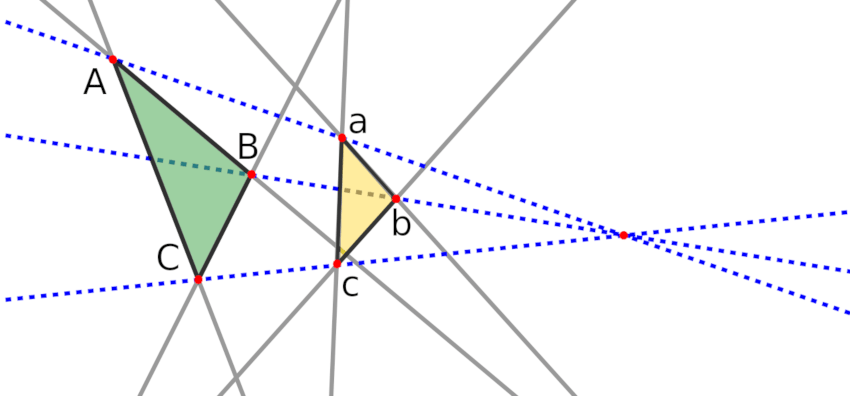
Diagram of Desargues' theorem, by Jujutacular

Yesterday I decided to integrate arpeggios into So What as a improvisation exercise rather than practice scales. The best arpeggios I know of are John Coltrane's improvisational solos. They are condense, intense and mind-expanding.

A great example is in A Love Supreme, Pt.II – Resolution. It gives me an adrenaline rush every time I hear it. Coltrane's improvisation starts at :52 until 1:14. It's a labyrinth of notes, a sonic theorem. He then hands it off to McCoy Tyner who improvises one of the greatest piano solos of all time. Check out the off-time chords starting at 2:23!

Coltrane's sax solos remind me of Page Hamilton's guitar solos in Helmet. During my nu-metal days Helmet were my favorite band because their guitar chord progressions and solos had a mathy, geometric ferocity to it. Page said many times his main influence was John Coltrane, a claim I initially found perplexing. Now I can totally see the resemblance in songs like You Borrowed, Turned Out, Wilma's Rainbow and many more.

In fact, today I found an interview where Page admits to transcribing John Coltrane solos to guitar !

So my insight today is I love compositions that twist and triangulate around a tonal center, and apparently always have. Jazz has this in abundance, and Helmet borrowed that element to great effect. Now I'm going back to the source.

Time bookstanding today: 40 minutes Quality of meditation (out of 10): 7

Two Things to Work On


Two Things to Work On

Picking away at more of So What. The intro is memorized now, but it's not smooth. My playing lacks expressiveness. It sounds ridgid, like speaking foreign dialogue without an accent. I need to work on getting different sounds from the same note, but that will be later.

As I study the sheet music, I notice the melody starts from D (minor, a friend told me) and rises to E flat (minor, said the same friend). I assumed the transition was an octave higher but it's merely a half note! Kind of embarrassing to even admit. Training my ear is another thing I need to work on.

Also, practicing scales across octaves is a killjoy for me. This is the second day I haven't bothered with it. In a timely video by Jens Larsen, he recommends minimizing non-musical practice and integrating arpeggios into the piece your working on instead. I love this idea. It's something I can stick to.

I'll probably put scales aside for the time-being and focus on So What, eventually fleshing it out with some improvisation.

Time bookstanding today: 40 minutes Quality of meditation (out of 10): 5