The Skies Parted


The Skies Parted

The last few days I've been grasping for ideas on how to start learning jazz improvisation on keyboard. Today, thanks to a video by Peter Martin of 2 Minute Jazz, I found a foothold. Peter teaches how to improvise with the right hand using only the C minor Blues scale and comp with the left.

When I saw the video for the first time it was like the skies parted and, well, you get the picture. It's an answer to my prayers.

So starting tomorrow my practice sessions are going to be a lot more structured. I'll start by practicing the Cm blues scale using Zach Evan's system, then practice left hand comping like Peter does. Last but not least is to continue with So What.

Looking forward to it.

Meditation Time bookstanding today: 40 minutes Quality of meditation (out of 10): 5

Practice Minutes on the keyboard today (out of 40): 15 minutes Quality of practice (out of 10): 6


https://write.as/poseur-to-composer/the-skies-parted

Abstract Art and Jazz Improvisation


Abstract Art and Jazz Improvisation

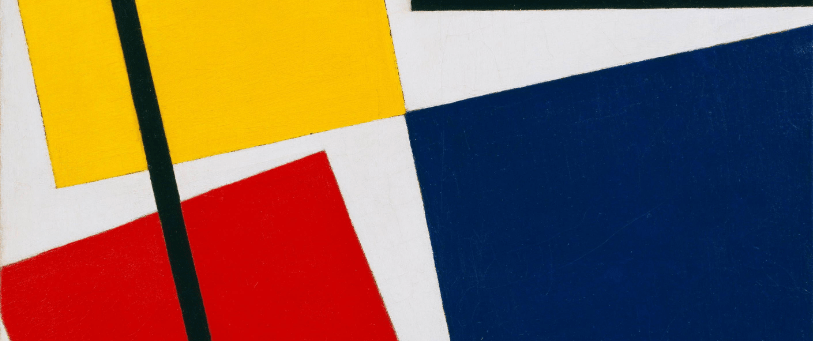
"Simultaneous Counter Composition" by Theo Van Doesburg

I'm only a few pages into the book Abstract Painting: Fifty Years of Accomplishment, from Kandinsky to the Present, but I see interesting parallels between abstract art and jazz improvisation, as defined by Free Jazz pioneer Ornette Coleman (in an interview with French philosopher Jacque Derrida).

Ornette Coleman says Jazz musicians are hard to surprise. Playing precomposed music isn't interesting to them because it's already been done. Instead of playing what they are told, they prefer to "destroy" a composition and re-create something more "democratic".

Likewise, to the practiced eye, abstract art contains few surprises because

everything is related, nothing manifests itself which has not been foreshadowed
(pg. 7). And

as early as 1909, the Cubists painters destroyed the object and reconstructed it in a different way, improvising freely with pictorial means and without taking objective reality into account. In doing so, the implicitly discovered the uselessness of the object and, in fact, proved themselves to be the first creators of abstract painting
(pg. 10).

I had the idea to learn about improvisation through other mediums other than music. It seems that abstract art may provide a meta-framework or mindset. I also had the idea of creating musical improvisations based on paintings from Pollock, Schwitters etc, but any paint or instrumentation in unskilled hands like mine can only create a mess.

Miles Davis was quoted saying: "Ideas are a dime a dozen; I can just look at a picture on the wall and come up with all kinds of ideas. But finding a sound is hard."

Sound advice.

Meditation Time bookstanding today: 40 minutes Quality of meditation (out of 10): 5

Practice Minutes on the keyboard today (out of 40): 10 minutes Quality of practice (out of 10): 5

Afterlife of Music


Afterlife of Music

This morning I woke up in existential angst. I tried to meditate but could only muster 20 minutes before giving up. That gave me extra time to get to work but was late anyway.

As the day went on, I wondered if this Poseur to Composer project will be of worth to anyone but myself. It's not the first time. As a Christian, I try to keep an eternal perspective, to make a positive contribution in the world, but I've been going through a faith crisis. My late nights and frantic days have only exacerbated my feelings of negativity and hopelessness.

Then at last work break I happened to read the far-out yet edifying Grammy speech by Ornette Coleman, iconoclast and founder of Free Jazz. Coleman had just won the Lifetime Achievement Award.

Here it is:

It is really very, very real to be here tonight, in relationship to life and death and I’m sure they both love each other.
I really don’t have any present thoughts about why I’m standing here other than trying to figure out something to say that could be useful to someone that believes.
One of the things I am experiencing is very important and that is: You don’t have to die to kill and you don’t have to kill to die. And above all, nothing exists that is not in the form of life because life is eternal with or without people so we are grateful for life to be here at this very moment.
For myself, I’d rather be human than to be dead. And I would also die to be human. So you can’t die, you can’t die to be neither one, regardless of what you say or think so that’s why I believe that music itself is eternal in relationship to sound, meaning, intelligence…all the things that have to have something to do with being alive because you were born and because someone else made it possible for you to be here, which we call our parents etc. etc.
For me, the most eternal thing is that I would like to live until I learn what it is and what it isn’t…that is, how do we kill death since it kills everything?
And it’s hard to realize that being in the human form is not as easy as wondering what is going to happen to you even if you do know what it is and it doesn’t depend on if you know what is going to happen to you.
No one can know anything that life creates since no one is life itself. And it’s obvious, at least I believe, it’s obvious the one reason why we as human beings get there and do things that seem to be valuable to us in relationship to intelligence… uh, what is it called…creativity and love and all the things that have to do with waking up every morning believing it’s going to be a better day today or tomorrow and yet at the same time death, life, sadness, anger, fear, all of those things are present at the same time as we are living and breathing.
It is really, really eternal, this that we are constantly being created as human beings to know that exists and it’s really, really unbelievable to know that nothing that’s alive can die unless it’s been killed. So what we should try to realize is to remove that part of what it is so that whatever we are, life is all there is and I thank you very much.

In the same way Coleman and his cohorts disperses sounds ("unstructured" might be the right word), he says in his speech that his music will live on forever. He reminds us that music and creativity is eternal. It's part of the human condition; essential to human existence. It's worth waking up for, suffering for, because it endures.

Meditation Time bookstanding today: 20 minutes Quality of meditation (out of 10): 4

Practice Minutes on the keyboard today (out of 40): 10 minutes Quality of practice (out of 10): 4