Rules for Piano Pupils


Rules for Piano Pupils

Turns I misunderstood the concept of family chords. They are not the same as major chords.

Robin was kind enough to clarify the issue on Udemy's Q&A section, and it makes sense to me. Sort of. I understand there are thousands upon thousands of piano chords one can potentially learn. But for the sake of efficiency and health of my arms, it makes sense to only learn chords that are in songs I actually want to play.

Based on that realisation, I know what my next step is. In other news... I finished Piano and Song by Friedrich Wieck today. It's a strange book, written in an eloquent style that is over-the-top. I found it enjoyable for just that reason, and because it offers lots of direction and advice for both piano teachers and students.

Here's Wieck's Rules for Piano Pupils. As you read this list in your mind, do it with a stuffy english accent and roll your r's. You must never begin to learn a second piece until you have entirely conquered the first. You ought to fix your eyes very carefully on the notes, and not to trust to memory; otherwise, you will never learn to play at sight. In order to avoid the habit of false fingering, you should not play any piece which is not marked for the proper fingers. You should learn to play chords and skipping notes, without looking at the keys, as this interferes with a prompt reading of the notes. You must learn to count nicely in playing, in order always to keep strict time.

He also follows up with this advice: Play and practise the bass part a great deal and very often, first slowly, then quicker, during one or two weeks, before playing the right hand with it, in order that you may give your whole attention to playing the bass correctly, delicately, and surely.
Mmm-mnemonics


Mmm-mnemonics

Let's face it. Memorizing piano chords is not fun. I find myself dawdling, reading articles and doing other small errands during my day off instead of hunkering down on this homework.

On one such lollygagging session I discovered Piano Chords & Progressions: The Secret Backdoor to Exciting Piano Playing by Duane Shinn. It teaches 144 music chords, 12 chords at a time. Looks like it might get me farther than Pianoforall.

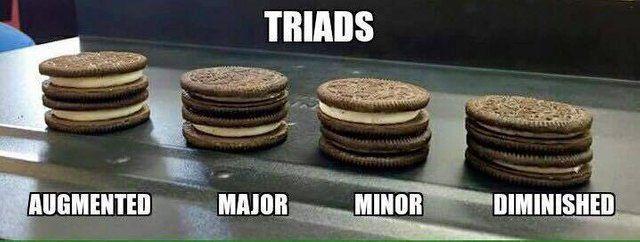
In this book Duane mentions how some major chords are like Oreo cookies; black keys on the outside and white key on the inside (the Eb Major Chord for example). A quick search on the internet shows this mnemonic is used elsewhere, along with similarly tasty comparisons to blackberry jam sandwiches, marshmallows and chocolate / vanilla ice cream (Source: Color Score).

Sure, these learning aids sweeten the deal and help the medicine go down a little better (sorry, no more food metaphors) but it's no substitute for the physical, repetitious practice required to imprint these chords into the hands.

Time to practice.

Kissing the Keys


Kissing the Keys

In Piano and Song: How to Teach, How to Learn, and How to Form a Judgment of Musical Performances, the author Friedrich Wieck, going under the name Dominie, emphasizes the importance of touching keys correctly. An incorrect touch, Dominie tells his student: makes too much unnecessary movement, and tries to produce the tone in the air, instead of drawing it out with the keys.
He continues: Above all things, I wish you to observe how I try to bring out from the piano the most beautiful possible tone, with a quiet movement of the fingers and a correct position of the hand; without an uneasy jerking of the arm, and with ease, lightness, and sureness. Although this book was published 144 years ago and written in a hilariously antiquated style, it is timely advice for me at this early stage of my learning. When I practice, my fingers on the left hand feel unsure. My right hand contorts to play the chords and I rarely get a clean sound. When I see others play the piano, their fingers look relaxed and gently kiss the keys.

I'm working on relaxing though, and "drawing the tone out of the keys". Whatever that means.