Today isday sixof my piano learning experiment. Day five was Sunday the sabbath, day of rest.This morning I did my daily7 minute workout. After two rounds of going full-out, I'm sweating and panting. It feels like enough exercise – that my time is well spent in those two seven minute drills. I wish I spent all my time as constructively.Then I thought about how I might make my white key practice more effective. What if I did a 7 minute, non-stop high-intensity white key drill? Would I get the same mileage as my workout?It's worth a try.So I developed a7 minute white key drillthat doesn't require signing up for anything. It's seven minutes long of me calling out random notes. I'm going to practice it tomorrow with the same focus and intensity that I bring to my 7 minute workout.
Yesterday I was over-thinking things. Instead of designating fingers to certain keys, I'll keep it simple and just memorize the white keys. One step at a time.This morning I printed out an unlabeled image seven white keys and five black keys in an octave:
I cut the image out and stuffed it in my front pocket. Then during the day, whenever I had a free second, I'd glance at the picture. Whatever key my eyes landed on first, I'd name it as fast as I could. Results are good. I'm correctly identifying most of the keys -sometimes instantaneously. This is while I'm doing other things and not even near a keyboard.My technique uses theactive recall method, by far the most effective way to commit information to long term memory. Through recall, we forge new neural pathways in the brain by integrating the new information with prior knowledge.I found a white keys memory exercise by Jacques Hopkins, a music teacher who has a YouTube channel calledPiano in 21 Days. I'm not going to link to the exercise directly because it bypasses the free5 day workbookyou have to sign up for and it wouldn't be fair to circumvent his sales funnel.Once I get 100 percent accuracy on the white keys memory test, I'll move on to the next step, whatever by internet consensus that next step is.
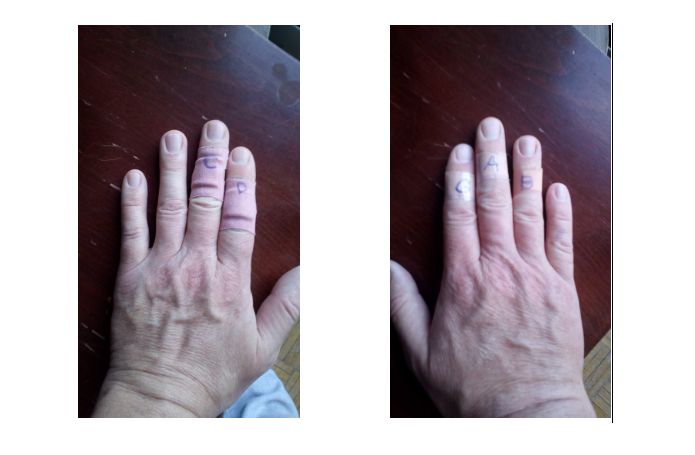
This isday threeof my learning piano experiment.I have an idea for how I might map the location of each white key into my muscle memory: I designated fingers for certain keys with band aids, as pictured below:This way my left hand's middle finger is trained to press the C note, and the index finger is trained to press the D note and so on. Once each of my fingers and thumbs instinctively know what note to press, I can take the band aids off.This will also help with visualization, a technique I'll be relying heavily on.As stated earlier, I have a bad case of tendinitis in both arms. I plan to visualize my fingers touching the correct note on demand, and even recreate the tactile sensations of it, to prevent overworking the tendons of my arms.Zig Ziglar, the successful salesman and motivational speakertells the storyof a U.S. prisoner of war in Vietnam who played a round of golf in his mind every day of his captivity. Years later, when finally released, he discovered that his golf game was better than before. It was all due to visualizing himself performing at an optimal level.This psychological technique is often calledthe inner game, a term first coined by Timothy Gallwey. I'm trying something similar. Let's call itinner piano lessons.I don't have years to practice this though. I want this memorized in the next day or so.I'll have a progress report for you tomorrow. Stay tuned.